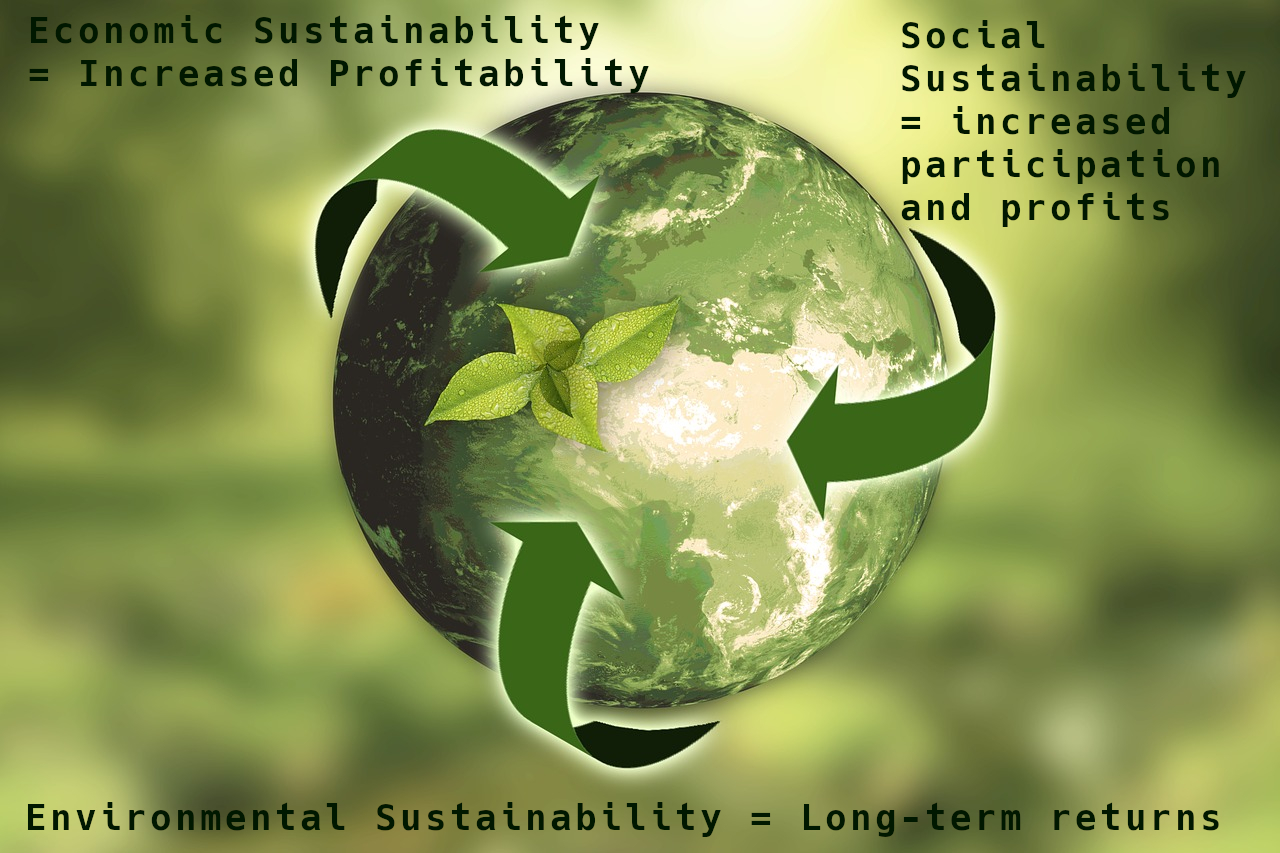
Systemic sustainability is an approach to sustainability that considers the interconnectedness of economic, environmental, and social systems. It recognizes that the three systems are not separate, but rather, they are interdependent and interact with one another.
Achieving systemic sustainability requires programs and projects that are integrated and that collectively are economically sustainable, environmentally sustainable, and socially sustainable.
Economic sustainability refers to the ability of an economic system to maintain its productivity and competitiveness over time. An economically sustainable system is one that generates income and profits while avoiding negative impacts on people and the environment. In the case of systemically sustainable investments, this in turn helps to assure that the investments will continue to provide returns for the long-term life of the project.
It requires a long-term perspective that takes into account the financial, social, and environmental costs and benefits of project and related economic activities. For instance, a company that invests in renewable energy sources to power its operations can reduce its long-term energy costs and increase its competitiveness. By doing so, it not only benefits economically, but also helps to reduce its environmental impact.
Environmental sustainability, on the other hand, refers to the ability of natural systems to maintain their ecological functions and biodiversity over time. An environmentally sustainable system is one that uses natural resources in a way that does not compromise their ability to regenerate, and that does not cause significant harm to ecosystems, biodiversity, or the climate.
This involves using renewable resources in a sustainable way, minimizing waste, and reducing pollution. For instance, a city that invests in public transportation and promotes cycling and walking can reduce its carbon footprint and improve air quality. By doing so, it not only benefits the environment, but also promotes public health and well-being.
Social sustainability refers to the ability of a society to meet the basic needs of its citizens and to promote social justice, equity, and inclusivity. A socially sustainable system is one that ensures access to basic services, such as healthcare, education, housing, and social protection, and that promotes social cohesion and respect for human rights.
It involves addressing issues such as poverty, inequality, discrimination, and exclusion, and promoting diversity, participation, and empowerment. For instance, a community that invests in affordable housing and community facilities can help to reduce poverty and promote social cohesion. By doing so, it not only benefits socially, but also reduces the economic and environmental costs of social exclusion and inequality.
Achieving systemic sustainability requires programs and projects that are integrated and that collectively address the economic, environmental, and social dimensions of sustainability. It involves recognizing the interconnections between the three systems and developing strategies that balance their interests and priorities. This requires a holistic and interdisciplinary approach that involves stakeholders from different sectors and levels, and that promotes collaboration, learning, and innovation.
For instance, an integrated program to promote sustainable agriculture can address economic, environmental, and social sustainability simultaneously. The program can provide farmers with training and technical support to adopt sustainable farming practices, such as organic farming, agro-forestry, or conservation agriculture. This can improve their productivity, reduce their environmental impact, and increase their income.
The program can also promote access to markets, credit, and insurance, and strengthen local institutions and governance mechanisms. This can enhance economic resilience, reduce poverty, and promote social equity. Finally, the program can contribute to biodiversity conservation, climate change mitigation, and soil and water conservation, thus promoting environmental sustainability.
Similarly, an integrated project to promote sustainable energy can address economic, environmental, and social sustainability simultaneously. The project can provide households and businesses with access to renewable energy sources, such as solar, wind, or hydro power. This can reduce their energy costs, improve their energy security, and increase their productivity.
The project can also promote energy efficiency measures, such as insulation, lighting, and appliances, and promote demand-side management. This can reduce energy consumption, reduce carbon emissions, and enhance environmental sustainability. Finally, the project can promote access to energy for the poor, promote gender equality, and address other social concerns in a more sustainable fashion creating more permanent results.